

Favour Ani and Safiya Shuaibu Isa (Lead writers)
In a stabilisation ward (a specialised treatment unit for severe malnutrition) in northern Nigeria, a child with severe acute malnutrition needs immediate action, not sympathy. That child needs swift screening, clear referral pathways, readily available therapeutic food, and health workers who are not forced to ration care. This is the real challenge Nigeria faces. Donor support is decreasing, and the country is entering a new budget cycle with a larger health budget allocation, but there is no clear commitment to prioritise child nutrition within that spending.
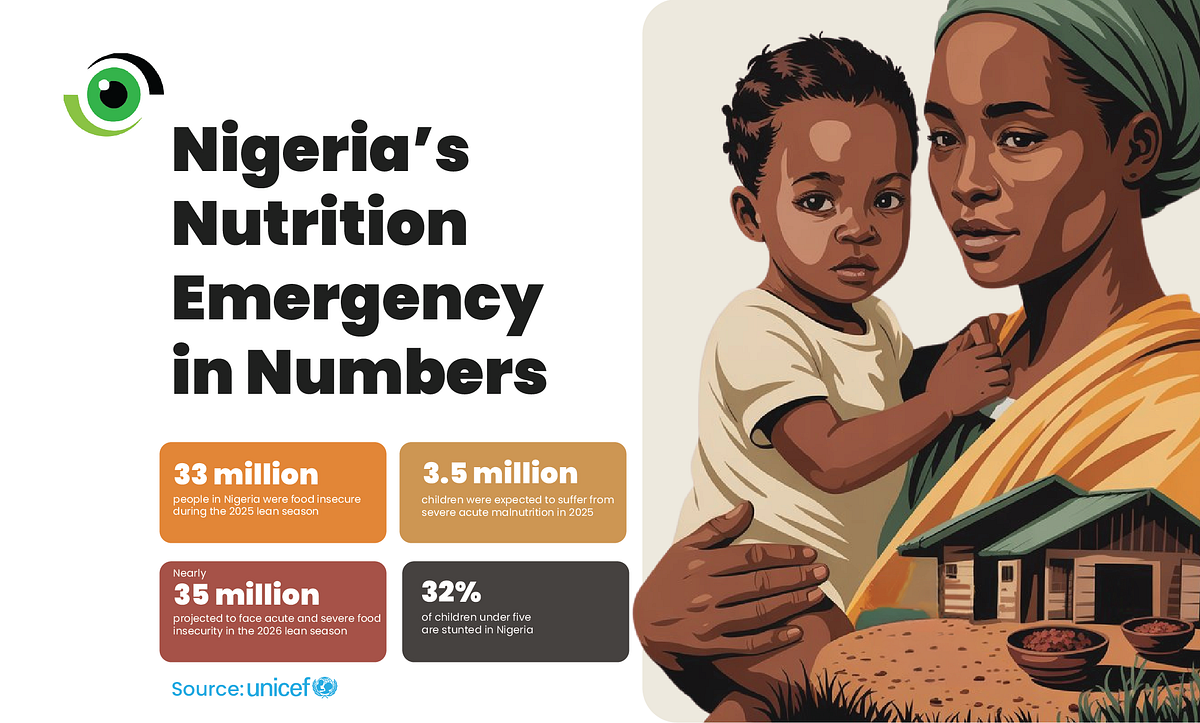
The level of need is already severe. UNICEF reported that an estimated 33 million people in Nigeria experienced food insecurity during the May–August 2025 lean season, and about 3.5 million children were expected to suffer from severe acute malnutrition. The World Food Programme (WFP) now warns that nearly 35 million people are projected to face acute and severe food insecurity during the 2026 lean season, the highest level recorded in a decade.
When families cannot reliably afford enough safe, nutritious food, the risk of wasting (severe weight loss and dangerously low body weight) increases significantly, especially for very young children already living in vulnerable conditions. This problem affects the entire country, but the most severe service disruptions occur in the north of Nigeria, where conflict, displacement, market shocks, and limited access to health services intersect.
In July 2025, WFP announced it would stop all emergency food and nutrition aid for 1.3 million people in northeast Nigeria due to severe funding shortages. It also warned that more than 150 WFP-supported nutrition clinics in Borno and Yobe would shut down, risking the health of over 300,000 children under two. By January 2026, the agency stated that its assistance in Nigeria would be limited to only 72,000 people unless urgent funding was received, and it required at least US$129 million to sustain operations until July 2026.
What may appear to be a small shift shows how quickly a fragile nutrition response can start to unravel when external funding weakens. But the deeper issue is that Nigeria’s nutrition crisis did not begin with the recent donor shock. UNICEF states Nigeria has the second-highest number of stunted children in the world, with 32 percent of children under five affected. It also reports that about 2 million children in Nigeria suffer from severe acute malnutrition each year, yet only about two out of every ten affected children receive treatment.
This means the system was already leaving too many children behind before the latest funding cut exposed how fragile treatment access had become. That is why the policy question for 2026 is not just whether the health budget is larger; it is whether nutrition is prioritised, protected, and actionable within that larger budget. President Bola Tinubu’s 2026 budget speech allocates ₦2.48 trillion to health.
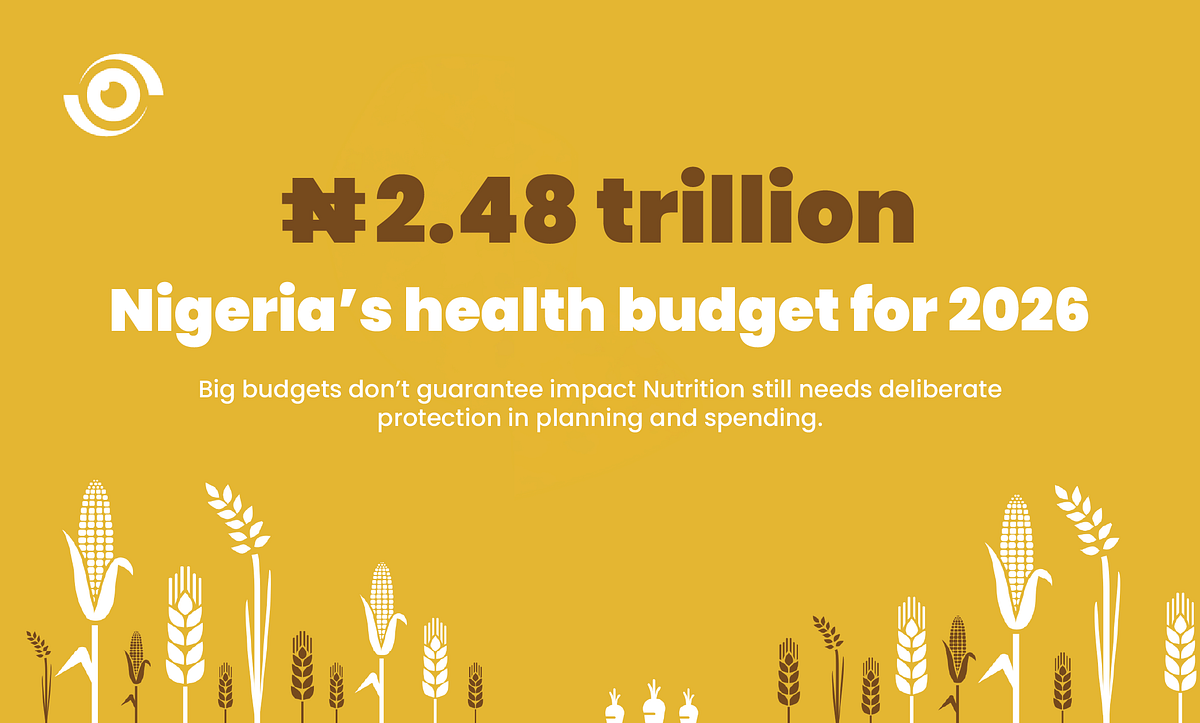
At first glance, this appears substantial. But in practice, a large envelope does not automatically mean better nutrition security. In Nigeria’s public finance system, allocations are not the same as releases, releases are not the same as expenditures, and expenditures are not the same as functioning services at the facility level. When nutrition is included within broad health budgets, it becomes harder to track, harder to defend, and easier to cut when fiscal pressure increases.
This is especially dangerous for severe acute malnutrition treatment because the entire care process depends on every step working, from detection to follow-up. Severe wasting significantly raises a child’s risk of death, but treatment is still possible. For uncomplicated cases, children can often be managed through outpatient care; more severe cases may require stabilization before discharge, along with therapeutic feeding support.
What this means in practice is that if screening fails, referrals fall through, ready-to-use therapeutic food (RUTF) supplies diminish, community follow-up weakens, children arrive later, more severely ill, and harder to save. UNICEF states the total cost of RUTF needed to treat a child with severe wasting is about US$100. This is not an impossible intervention. It is a vital one that remains financially fragile.
Nigeria should also be clear about the transition it is currently undergoing. The country is concluding the 2021–2025 National Multi-Sectoral Plan of Action for Food and Nutrition, which sets ambitious goals to reduce malnutrition, promote breastfeeding, decrease stunting, and improve coordination. Meanwhile, the Federal Government has stated that its ongoing review of the national food and nutrition policy framework is expected to result in a 10-year roadmap for 2026–2035.
That creates a rare policy window. However, a new plan will only be credible if it begins with a clear account of the previous one, including what was budgeted, what was released, what was implemented, what improved, what stalled, and where accountability failed. Without that baseline, Nigeria risks developing a new nutrition roadmap based on old blind spots.
The same principle applies to Nigeria’s international commitments. In the official annex to the 2025 Nutrition for Growth Summit, Nigeria pledged to establish and operationalise nutrition departments with dedicated budget lines across 12 MDAs, launch the Nutrition 774 Initiative, strengthen the national nutrition data landscape, increase investment in multisectoral nutrition action, and review national and sectoral nutrition policies and plans.
Those are serious commitments, but they should not be regarded as proof of progress on their own. The more important question is whether they will be backed by timelines, designated institutional responsibilities, public reporting, and visible financing decisions in federal and state budgets. Commitments matter, but enforceability is even more crucial.
This is where the Basic Health Care Provision Fund (BHCPF) needs more focus in discussions. The BHCPF is not just another source of funding. It exists to support a Basic Minimum Package of Health Services and to improve primary health care delivery. This is important because PHC is where most prevention, early detection, counselling, referral, and routine nutrition support should be centred.
If nutrition continues to be mainly funded through emergency or partner programmes, it will stay vulnerable. If it is more deliberately integrated into domestic PHC financing, it has a better chance of surviving funding shocks and becoming part of routine service delivery instead of a rescue response.
Nigeria should therefore be judged in 2026 not by how often nutrition is mentioned in speeches, but by whether five things happen.
- First, treatment for severe acute malnutrition and essential nutrition commodities should be clearly visible in federal and state budgets, not hidden within vague aggregate lines.
- Second, governments should publish not only allocations but also actual releases and expenditures.
- Third, RUTF procurement, stock monitoring, and distribution should be safeguarded against the kind of pipeline disruptions now threatening care in the North.
- Fourth, treatment coverage should be expanded in the highest-burden states, not just maintained where it already exists.
- And fifth, the new 2026–2035 roadmap should be launched with a public accountability framework that specifies indicators, timelines, financing responsibilities, and reporting mechanisms.
Nigeria’s nutrition crisis should no longer be viewed as a donor-driven emergency controlled by local interests. Instead, it should serve as a vital test of governance, public finance, and the country’s commitment to development.
As Nigeria heads into 2026, it faces a larger health budget, an old nutrition plan nearing closure, a new one in development, and diminishing donor support. That combination should force a harder reckoning.
The real question is no longer whether Nigeria can accurately describe the nutrition crisis. It is whether Nigeria will finally fund the response as if child survival, human capital, and national development depend on it, because they do.