

It has been my pleasure to share with you some of my reflections from AIDS2010, from a Nigerian perspective. I have not covered in detail a lot of the interesting scientific issues emerging from the conference. The hope of new vaccines, microbicides, and the relative success of programmes from around the world, and emerging epidemics in eastern Europe. You can watch webcasts of most oral sessions here.
It is important that you the reader pay particular attention to the areas I have not spoken about. The sad data coming out of Nigeria, and the absence of leadership from our Ministry of Health at this conference, as well as the little scientific research from Nigeria – all lost opportunities. The name of our country’s capital was often mentioned at this conference, but not for anything happening in our country, but in the context of the “Abuja Declaration” where African countries committed to spending 15% of their budgets on health. This has not happened in any African state and definitely not in Nigeria. Our representatives in the Nigerian senate have just approved 17 Billion Naira to “celebrate” 50 years of our comatose existence.
I recall one particular session I attended on advancing country ownership of HIV and AIDS programmes, and reflect on an interesting tool called National AIDS Spending Assessments (NASA). These are designed to describe the financial flows for the response to AIDS in different countries. The NASA for Nigeria is compulsory reading for anyone interested in this area in Nigeria. You can find the report here. Below are the two most important facts in the report to ponder on;
Nigeria spent a total of US$ 300M (N35Billion) in 2007 and US$ 400M (N45Billion) in 2008 on HIV and AIDS
External financing sources accounted for 85.4% of all HIV expenditure in 2007 and increased to 92.3% in 2008.
Lets think about this – in 2008, 92% of all funds spent on Nigerians, the 7th largest oil producer in the world was from donor funds!
Through my interaction with colleagues involved with the response in Nigeria, I can report that the coverage for the Prevention of Mother to Child Transmission of HIV(PMTCT) is about 10% and that only about 30% of people living with HIV, for whom treatment is recommended according to the old guidelines ( CD4 < 250/mm2) get treatment.
Lets think about this – 10 years after Durban only 1 in 10 children born to mothers with HIV will receive life saving antiretrovirals.
Challenging thoughts for Nigerians to ponder on….


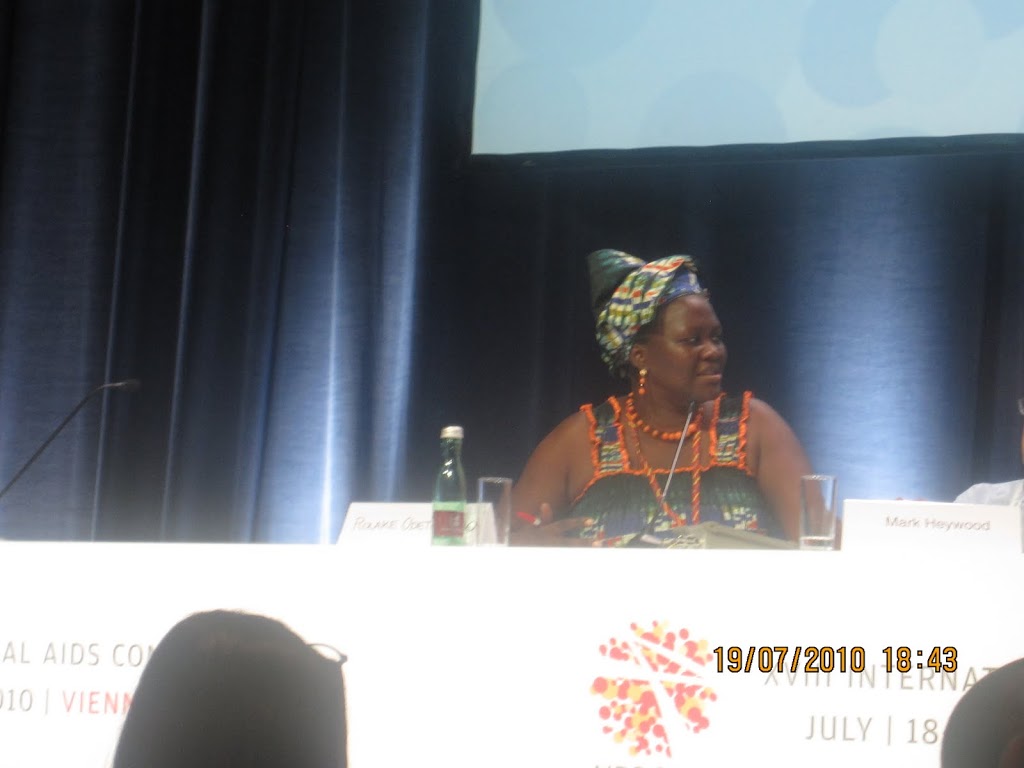
Let me end on a personal note. At these conferences, one always meets interesting and inspiring people. I met several people that commit so much time and energy to the response to HIV/AIDS. But the one person that made an impression on me, was Rolake Odetoyinbo. Rolake was the most prominent face from Nigeria at this conference. At home, she is director of the Positive Action for Treatment Access (PATA), a non government organisation. From speaking at sessions, to chairing sessions she was all over the place – eloquently, passionately and articulately making the case for an improved response to HIV and AIDS, especially in Nigeria.
Rolake has been living with HIV for over 10 years and has seen her life change, from one where she lived in fear, silence and stigma to a positive, active and fulfilled one. I sought her out, and we had lunch. I left the conference relieved that there were still some real leaders among us and that one day, we will overcome the pain of the present state of affairs in Nigeria. She left me convinced that every country deserves the leadership it has, and that as long as Nigerians choose to sit around and moan, and do nothing more, we will have what we have…and we will have to live with it. Find below a clip from her talk at the TAC Satellite session and apologies for the audio quality!
That’s it from the conference….! We will appreciate your feedback
Never doubt that a small group of thoughtful committed people can change the world; indeed it is the only thing that ever has…Margaret Mead