


Zubaida Baba Ibrahim (Lead writer)
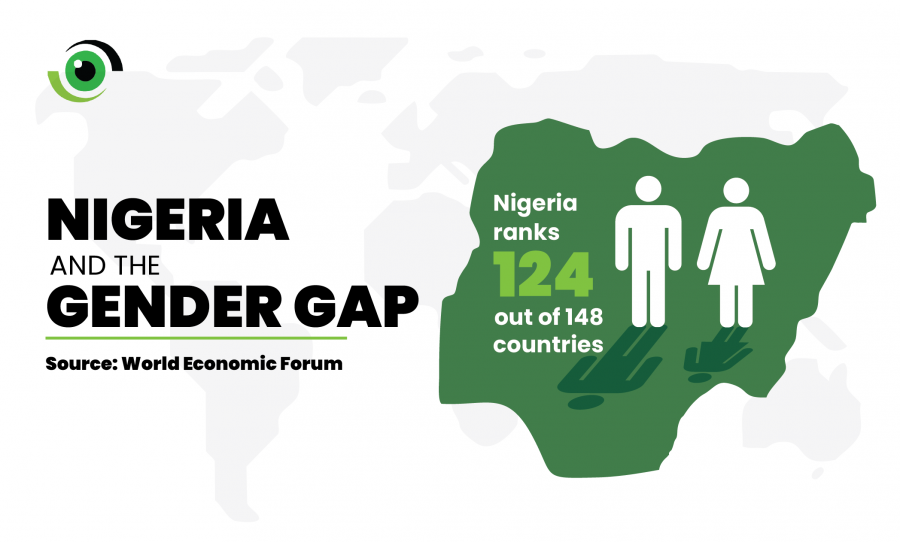
With less than five years remaining to achieve the 2030 Sustainable Development Goals, progress on gender equality remains tremendously slow. The World Economic Forum states that68.8% of the global gender gap has been closed, and full parity is still 123 years away. In Nigeria, the situation is even more critical. Nigeria ranked 124th out of 148 nations on the 2025 Global Gender Gap Index, with women occupying just 3.91% of the seats in the National Assembly and 8.82% of ministerial positions. Longstanding evidence from the World Bank shows that gender inequality hampers growth and makes reducing poverty more difficult. If sub-Saharan Africa had closed gender gaps in education at the same rate as East Asia did between 1960 and 1992, the region’s per capita growth could have doubled.

If Nigeria is serious about saving lives, reducing poverty, and building a more productive economy, it must make four deliberate investments in women and girls.
(1) Invest in maternal and reproductive health
Nigeria’s maternal mortality rate remains among the highest worldwide, reflecting both weak health services and deeper social inequality. Postpartum haemorrhage (PPH) continues to be the leading cause of maternal death, while Nigeria’s modern contraceptive use among married women is only 15%. This indicates that many women still face risks during pregnancy, childbirth, and postpartum without reliable access to contraception and other essential reproductive health services.
Nigeria should therefore invest in robust primary health care, skilled birth attendants, emergency obstetric and newborn care, referral and transportation systems, and voluntary family planning. These are not limited to health sector costs; they are economic and social investments. The Guttmacher Institute estimates that every extra dollar spent on contraceptive services in low- and middle-income countries reduces pregnancy-related and newborn care costs by about three dollars. The United Nations Population Fund (UNFPA) also estimates that expanding family planning and maternal health programmes could generate up to $660 billion in economic benefits by 2050. In Nigeria, these investments would save lives, decrease catastrophic health expenditures, and protect household stability.
(2) Invest in women’s economic empowerment and financial inclusion
Nigerian women work, trade, farm, save, and support their households, yet many remain trapped in low-income, vulnerable jobs. World Bank data shows that 78.9% of women’s employment in Nigeria was classified as vulnerable in 2023. In 2024, only 52.2% of women had an account in a financial institution, compared to 74.3% of men. Also, only 36.5% of women saved through an account or mobile money. A 2024 report from Enhancing Financial Innovation and Access (EFInA) also indicates that only 22% of women in Nigeria are economically empowered.
This is why women’s economic inclusion must be approached as a systems issue, not just a microcredit problem. Nigeria should broaden women’s access to accounts, savings, credit, identity, digital payments, productive assets, and markets. It should also address legal and structural barriers related to land, collateral, and economic rights. The same World Bank data show that 88.5% of women aged 15 to 49 do not own land, and Nigeria scored 66.2% on women’s economic rights in 2023. EFInA also found that women with formal savings are 6.9 times more likely to be economically empowered. When women can save, transact, own assets, and use financial tools safely and consistently, households and local economies become more resilient.
(3) Invest in women’s political representation and voice in decision-making
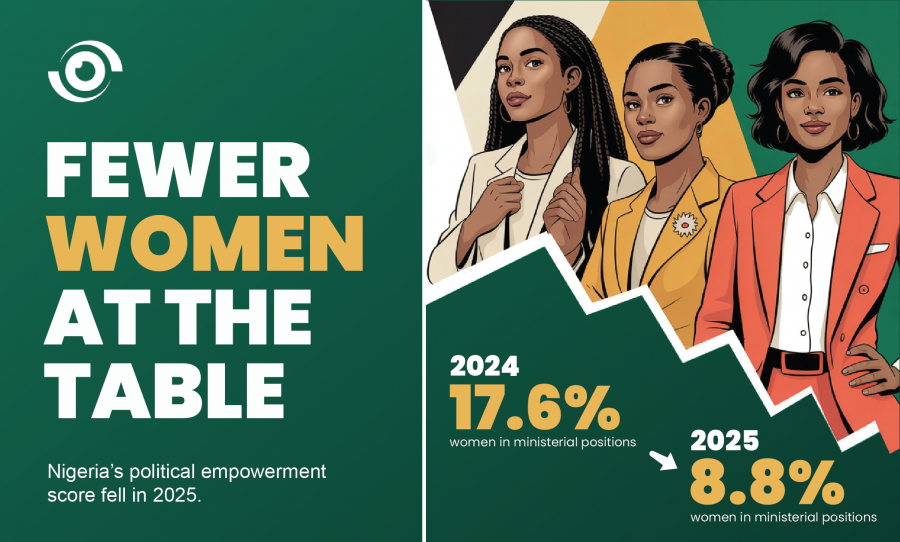
Nigeria cannot create an inclusive policy environment if women are pushed to the margins of formal power. Women held only 3.91% of national parliamentary seats in 2024, compared to 26.9% across sub-Saharan Africa. The World Economic Forum also reported that women’s ministerial representation in Nigeria decreased from 17.6% in 2024 to 8.8% in 2025, resulting in a significant decline in the country’s political empowerment score.
This matters because representation influences priorities, visibility, and accountability. A growing body of evidence across settings links increased women’s political representation with greater investment in public goods and better maternal and child health outcomes. Although the Reserved Seats for Women Bill proposes creating women-only seats comprising 37 in the Senate, 37 in the House of Representatives, and three in each State House of Assembly, quotas alone cannot address the structural barriers that limit women’s political participation. Nigeria must invest in women’s political leadership through political party reforms that promote gender inclusion, financial and technical support for female candidates, expanded campaign financing pathways, stronger protection from political violence, and institutional incentives that encourage women’s participation.
(4) Invest in girls’ education and literacy
Investing in girls’ education is one of the most impactful investments a country can make. The World Bank has shown that if all girls completed 12 years of quality education, women’s lifetime earnings could increase by $15 trillion to $30 trillion globally. Women with secondary education earn almost twice as much as women with no education. Universal secondary education could eliminate child marriage, reduce the risk of early childbearing by 75%, and reduce fertility by one-third in high-fertility countries.


For Nigeria, that situation is urgent. UNICEF reports that about 10.5 million children aged 5 to 14 are out of school in Nigeria, with girls often being the most excluded. A UNICEF Nigeria update states that girls make up 60% of primary-school-age children who are not in formal education. In northern Nigeria, female attendance remains particularly low due to poverty, insecurity, and harmful social norms. Education for girls must go beyond just getting them into classrooms. It should also include safe schools, pathways to secondary education, re-entry options for adolescent mothers, digital skills, school WASH, menstrual health support, and access to reliable health information.
Nigeria does not need to choose between justice and development. Investing in women and girls provides both. Maternal and reproductive health saves lives and shields families from economic shocks. Financial inclusion and economic rights boost productivity and resilience. Political representation enhances voice and policy responsiveness. Girls’ education transforms health, earnings, and opportunities across generations. These are not women’s issues sitting at the margins of policy; they are nation-building investments. And Nigeria is already paying the price for delaying them.