

Zubaida Baba Ibrahim and Precious Ajayi (Lead writers)
Nigeria recorded an estimated 14,000 cases of armed violence between 2018 and 2024. During this period, the share of the population facing food insecurity rose from 47% to 75%. While the escalating wave of violent attacks is severely undermining Nigeria’s internal security, it is also taking a significant toll on the nation’s food security.
In the 2025 Global Hunger Index, Nigeria ranked 115 out of 123 countries with a score of 32.8. This suggests that the country falls into the category of “serious hunger,” emphasising the deepening impact of insecurity on nutrition and overall public welfare. “Insecurity disrupts all pillars of food security such as availability, access, utilisation and stability,” Abdulaziz Mala, a security analyst with experience in the Lake Chad crisis, explained.
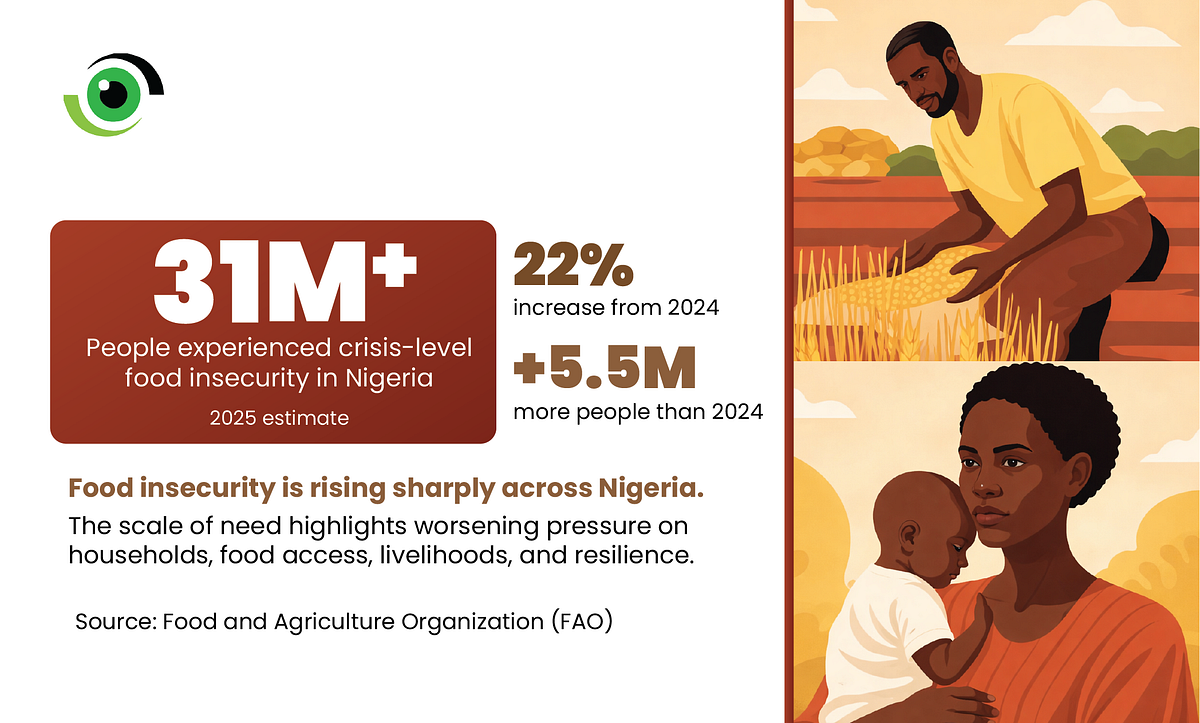
Currently, malnutrition remains one of Nigeria’s most urgent public health crises. According to an analysis published in March 2025 by the Food and Agriculture Organization of the United Nations (FAO), about 31 million people in Nigeria are projected to face acute food and nutrition insecurity (crisis-level or worse) during the 2025 lean season. The analysis also noted that this represents a sharp 22% increase from the previous year, with around 5.5 million more people facing critical food insecurity compared to 2024.
The crisis is particularly worse in the northern part of the country, where persistent insecurity, widespread poverty, disrupted livelihoods, and recurrent food shortages have severely limited access to nutritious food and health services.
The geography of insecurity and its impact on the nation’s food supply
Malnutrition in Nigeria shows pronounced regional disparities, with northern states facing much higher rates than those in the south. It is also influenced by multiple forms of insecurity, including insurgency, banditry, and farmer-herder conflicts, which are particularly prevalent in certain geopolitical zones and disrupt different dimensions of food security. These overlapping pressures limit food availability and deepen nutritional vulnerabilities. “While all forms of insecurity harm nutrition, the severity varies by mechanism,” Mala explained.
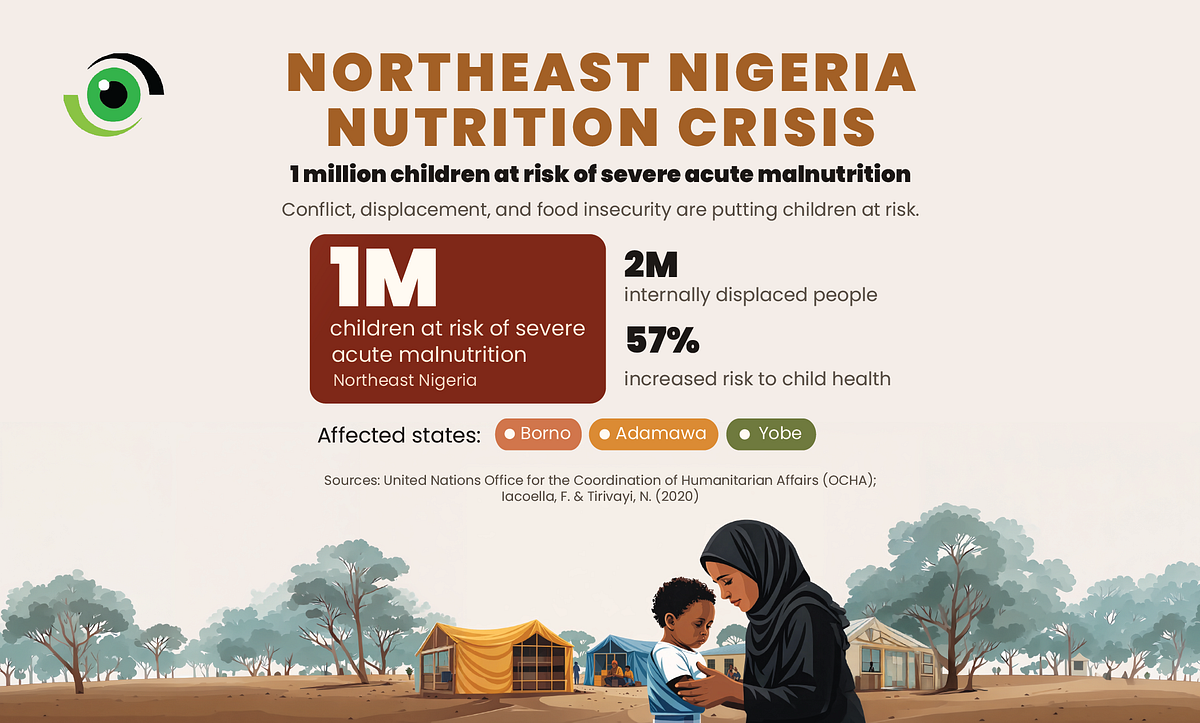
In Northeast Nigeria, the Boko Haram insurgency has led to a severe acute malnutrition (SAM) burden, with at least 1 million children at risk due to prolonged conflict. Displacement is another major driver of malnutrition. The instability in the region has led to massive displacements, accounting for 2 million Internally Displaced People (IDPs) in Borno, Adamawa, and Yobe states alone. This has increased the risk of severe food insecurity and poor child health by 57%, and increased dependence on humanitarian aid in many garrison towns within the states.
In the North West of Nigeria, where banditry and kidnapping for ransom are widespread, food and access to food are often weaponised, leaving communities unable to sufficiently feed themselves. In Zamfara, Katsina, and Kebbi states, where the majority of residents depend on farming, bandit groups have reportedly attacked farmers on their farmlands, destroyed crops and food stores, and imposed taxes and levies on harvested crops. Mala explained that the strategy behind this is to disrupt livelihoods and weaken the food supply, and to cause disorder. “These [banditry and kidnapping] have been the main drivers of food insecurity nationwide as it also disrupts major agricultural trade routes,” he said.
In the North-Central zone, including Benue, often referred to as the nation’s food basket, insecurity takes a different form. While some banditry exists, the main security challenge is farmer-herder clashes, which have disrupted the supply of animal-sourced foods. “While highly disruptive, these clashes are largely localised,” Mala explained. In some areas of the North Central, up to 94.2% of farmers have abandoned their farms due to threats and fear of attack, further weakening local food production. However, in other parts of Nigeria, even where nutritious foods appear to be available, many households often lack the economic means to access them, with poverty limiting access to essential nutrients.
Breaking a vicious cycle
To break insecurity’s toll on malnutrition in Nigeria, the government and key partners need to address immediate survival needs and long-term agricultural resilience by:
1. Strengthening security for farming communities and critical trade routes
Nigeria must embrace a community-based security framework, shifting from largely reactive military responses. This means institutionalising traditional peace structures with legal recognition, early warning roles, and deploying security personnel directly to high-risk farming areas to prevent attacks before they escalate.
At the same time, prioritise the rehabilitation of abandoned access roads and rural markets to restore trade routes and stimulate local food production; without these, agricultural outputs would remain trapped where they are produced and cannot reach consumers or markets.
2. Expand social protection for vulnerable households.
To help displaced and vulnerable households cope with food price shocks and lost livelihoods, Nigeria will need to expand social safety nets, such as cash transfers, agricultural support, and short-term in-kind assistance. In Ethiopia, the multi-year Productive Safety Net Program (PSNP) provided cash and food payments for public works that build local infrastructure or protect the environment.
Vulnerable households with limited labour capacity received unconditional payments. However, these depend on functional, accessible food markets; if markets are destroyed by conflict, short-term in-kind assistance remains the most effective bridge to ensure food access.
3. Invest in local food production and climate-resilient short-term agriculture in safe zones.
To secure Nigeria’s future food supply, the country must invest in climate-smart agriculture within secure safe zones where farmers can safely cultivate food regardless of climate change, while rebuilding local production systems. For example, India has scaled solar-powered irrigation systems that allow farmers to irrigate crops without relying on expensive diesel pumps or unreliable electricity.
The use of recycled wastewater, artificial intelligence, and Internet of Things (IoT)-based sensors enables the monitoring and analysis of soil conditions and weather patterns. Nigeria can adopt a similar approach by investing in solar irrigation, improved drought-tolerant seeds, and small-scale storage and drying technologies in stable farming areas. These investments would enable farmers to maintain production despite climate stress and reduce post-harvest losses.
Addressing a crisis of this magnitude requires coordinated, multi-sectoral action spanning the security, health, agriculture, and humanitarian sectors. Strong policy alignment is also critical. Nigeria can learn from countries that have implemented integrated national strategies, bringing together government ministries, social protection programmes, and civil society under a shared commitment to ending malnutrition.