

By Hafsat Bello
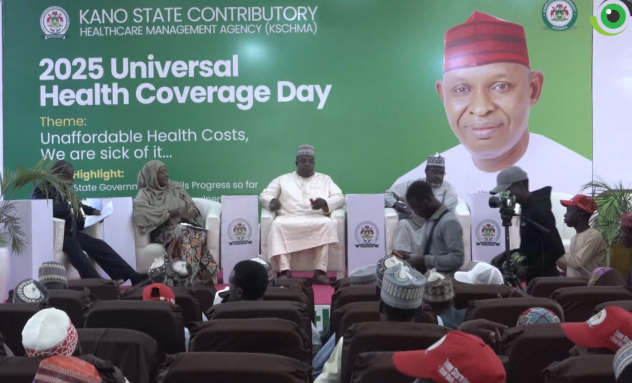
While marking the 2025 Universal Health Coverage (UHC) Day at a one-day symposium organised in Kano State, the Kano State Contributory Health Care Management Agency (KSCHMA) enrolled 200 more beneficiaries from the informal sector, who are petty traders, street vendors, and market women and men.
As enrolment reaches 900,000 beneficiaries, many residents remain unaware of enrollment benefits and perceive healthcare as costly, discouraging facility use. This has led to continued home births in rural communities, increasing health risks by seeking alternative solutions, such as Patent and Proprietary Medicine Vendors (PPMVs), herbal medicine, among others.
Ongoing community sensitisation, particularly through effective town hall meetings, is crucial for addressing misconceptions and increasing enrollment.

The Executive Secretary of KSCHMA, Dr Rahila Aliyu Mukhtar, reflects on the challenges of the ongoing state-wide enrollment. “The ever-changing population of Kano State has led to changing figures, which has affected how we compute our data, but we will keep enrolling until we reach our target of over one million people before next year,” Mukhtar noted.
The Commissioner of Health, Dr Abubakar Labaran Yusuf, speaking at the event, urged residents, particularly those in the informal sector, to take advantage of the health insurance scheme, explaining that enrollment is open through multiple gateways. “The public is entitled to enrol through any of the available gateways, formal, informal, or vulnerable. I urge people in the informal sector to approach the agency and enrol in the scheme,” he emphasised.
Musa, a petty trader enrolled during the UHC Day outreach, noted that “I didn’t know enrollment was this easy. I usually avoid hospitals because of cost, but now I feel more confident seeking care for my family.”
For many informal workers like Musa, live enrollment exercises remove long-standing fears about bureaucracy and hidden costs; therefore, the enrollment surge reflects growing public trust and inter-agency collaboration between PHC and hospital management boards.
However, raising insurance coverage is only one factor in achieving UHC. Improving the quality of care by increasing the number of qualified health workers and expanding access to health facilities is equally essential to ensure that no one is left behind.
KSCHMA’s enrollment drive aligns with Nigeria’s Health Sector Renewal Investment Initiative, which identifies efficient, equitable, and quality healthcare systems as one of its core pillars by reducing financial barriers and strengthening PHC utilisation across Kano State.
Government and partners should therefore
- scale enrollment outreaches,
- continue to strengthen health facility capacity, and
- intensify public awareness, especially among informal-sector workers.
UHC is not just about numbers enrolled; it is about ensuring every Kano resident can access care when it matters most.