
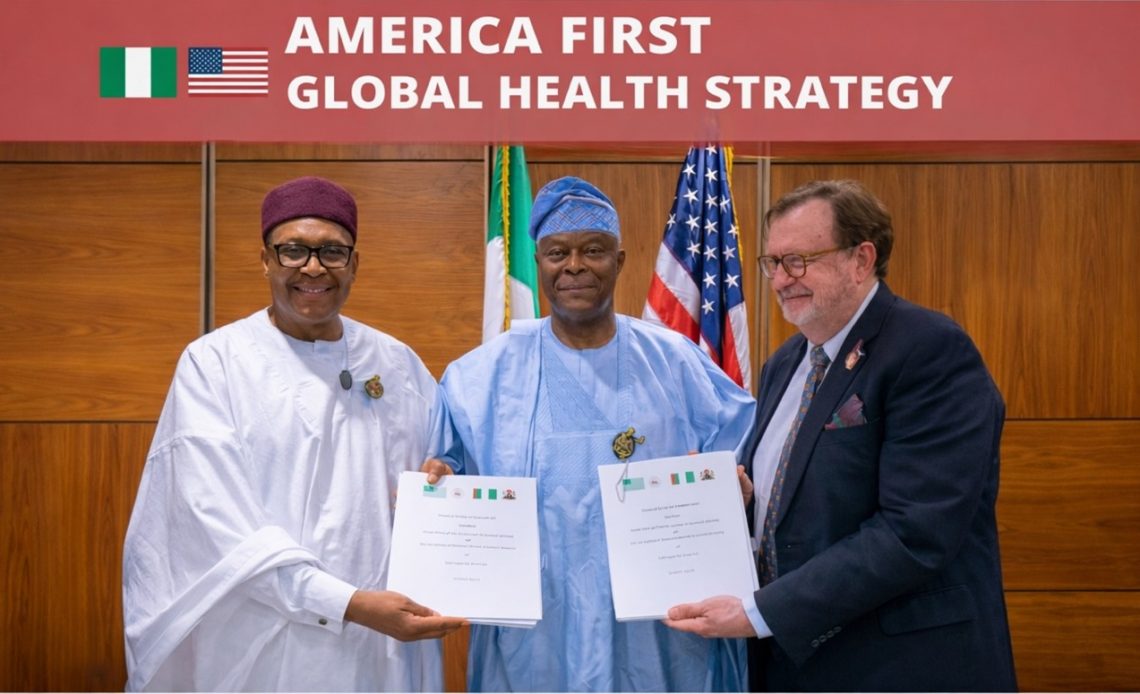
At the start of every year, Nigeria Health Watch takes stock of the trends likely to influence Nigeria’s health landscape. This year is different. Instead of a wide-ranging reflection,we focus on the newly signed Nigeria–United States health Memorandum of Understanding, as it may be one of the most consequential development shaping health financing, delivery, and accountability in Nigeria throughout 2026.
Just before Christmas, on the 19th of December the Coordinating Minister for Health and Social Welfare and Coordinating Minister for Finance met with the outgoing United States Ambassador to Nigeria to sign a new bilateral Memorandum of Understanding (MoU) to fund agreed public health priorities. The agreement is one of several MoUs the United States Government (USG) is signing with African countries as it restructures health assistance, following the dissolution and restructuring of USAID, PEPFAR, PMI and other aid delivery vehicles. The stated rational under the America First Global Health Strategy is to reduce inefficiencies and address aid dependency, objectives presented as pragmatic, if ambitious.
This raises an obvious question. What in practical terms does such an MoU mean for Nigeria, and what is its legal standing in both countries? An MoU is a formal statement of intent, not a legally binding agreement in either country. In the United States, each commitment will still require appropriation by Congress. The same applies to the “co-funding” pledges by the Nigerian Government, which will need to be secured in future budget cycles, before any promise can translate into spending.
This reality introduces significant uncertainty into any multi-year agreement, given the political realities in both countries. One just needs to look at the level of implementation of the Abuja Declaration. A commitment by African Heads of State to commit at least 15% of annual national budgets to health, to understand how seriously we take statements of intent in Nigeria.
Potential Upsides for Nigeria’s Health System
Taken at face value, the bilateral MoU between the US and Nigeria, does have merits. The most immediate is the scale of the funding. A five-year commitment of roughly $5billion to Nigeria’s health sector, including $2.1 billion from the United States Government, is substantial by any measure. No other foreign partner comes close to this level of support. For a health sector under sustained fiscal pressure, the size of the proposed investment alone merits serious attention.
The bulk of planned funding targets disease specific programmes that have already saved many lives, notably HIV, tuberculosis and malaria. These have been areas that the United States has focused on over many years, with spending concentrated on commodities and health workers. The MoU also proposes investments in surveillance and outbreak response, laboratories, emergency operations centres, as well as investments in primary health care. Together, these priorities reflect America’s emphasis on health security, an agenda that aligns, at least in part, with Nigeria’s own interests.
Another potential benefit lies in how funds may be directed. Over time, United States health financing in Nigeria has typically been implemented through Washington DC based non-governmental organisations (NGOs). These NGOs weakened the role of national institutions such as the Federal Ministry of Health and health parastatals, while creating parallel delivery systems through local NGO sub recipients. After 20 years of this approach, it is surprising that national public health institutions struggled to develop capacity. How could they have, under these conditions of parallel, well-funded, NGOs taking over their responsibilities?
If the new bilateral agreement enables the effective flow of funds, with the appropriate fiduciary mechanisms through public institutions, then Nigeria maybe onto something. In five years’, time we should see strong national public health institutions. However, it is still not clear how the funds will flow. The MoU summary appears silent on these details. It will be interesting to see whether the United States Government is prepared to entrust Nigerian Government institutions with managing these resources.
Whatever the mechanism that is decided, operationalising this novel funding approach, at this scale and speed without the institutional support that USAID has previously provided is fraught with pitfalls. Anyone who has implemented a United States grant will understand this. It will also be interesting to see how Nigeria will balance the opportunity with the associated fiscal realities and accountability requirements.
What Nigeria Needs to Be Clear About
To understand the MoU in context, one must understand the foundation in the “America First” Global Health Strategy. In the foreword to the strategy document, the United States Secretary of State for Marco Rubio makes no secret about the goal — “…to make America safer, stronger, and more prosperous.” He adds “…We will continue to be the world’s health leader and the most generous nation in the world, but we will do so in a way that directly benefits the American people and directly promotes our national interest”. The Secretary has made the goals of the United States Government clear. So, Nigeria must go into this relationship with their eyes wide open! This is not about us. The United States Government has not said that their goal is to make Nigerian people healthier, safer or more prosperous.
A reasonable question, however, is what does the United States receive in return? The final signed MoU has not yet been made public, so all we have to go on is a short summary released by the Ministry’s SWAp Coordination office. It would serve the country and build trust if the full agreement is placed on the Federal Ministry of Health and Social Welfare’s website, in full transparency. Making the MoU publicly accessible would help assure Nigerians, that their interests are being fully protected by the government they have elected.
A clause on page five in the circulated summary committing to sharing data on the health of Nigerians is quite concerning. Similar language has generated debate other countries in Africa that have signed similar MoUs. The language in the summary states that “…Both countries intend to negotiate a regulated data sharing arrangement to exchange information on long term performance of the MoU, in compliance with the applicable laws governing data protection, ownership, privacy, access, rights and hosting requirements”.
The template of the MoUs that was circulating included stronger language on direct access to national databases and also made several references to the sharing of pathogens and pathogen sequence data with the United States for 25 years. Until the final signed MoU signed between Nigeria and the United States is made public, it is not possible to fully understand the commitments made or their implications for Nigeria’s sovereignty. Clarifying whether such provisions are in the signed document will be essential to addressing legitimate public concerns. This raises an important issue. Is health data ownership and control now a defining strategic currency of influence?
The most sensitive issue appears in the final paragraph of a press release issued by the United States Embassy in Nigeria. We reproduce the text below without commentary, allowing readers to consider its implications in the broader context of health cooperation and governance.
The MOU was negotiated in connection with reforms undertaken by the Government of Nigeria to prioritize the protection of Christian populations from extremist violence. As with all U.S. foreign assistance, the President and Secretary of State retain the right to pause or terminate programs that do not align with U.S. national interests, and the United States expects Nigeria to continue making measurable progress in combating religiously motivated violence against Christian communities.
So, what is the opportunity?
The biggest price may be the domestic; the ambitious co-financing commitments, that countries have been asked to sign off on. In Nigeria’s case, this involves a pledge to invest roughly $3 billion into the health sector over a comparable period. It is not clear whether these are resources represent new funding or a repackaging of existing allocations. If these are new funds and if the five-year transition is adhered to, the arrangement could provide a pathway towards a more sustainably funded public health system.
It is important to recognise that we should never have been in this situation in the first place, where the health of our population depends so heavily on the priorities of a single external country. Countries that are able to finance large infrastructure projects (as important as they are for economic growth) and sustain expansive government spending on the privileges of politicians should also be able to fund essential health services, from vaccines for our children to the treatment for chronic diseases. The real test of this agreement will be whether it enables Nigeria to reduce the dependence of the health sector on aid over time, rather than entrench it further.
As the support from United States Government declines over the next five years, as set out in the agreement, the Nigerian government will need to prioritise additional domestic resources for health. We must take charge of our destiny, avoiding a return to the aid dependent status quo. This will require a deliberate policy choice, including reprioritising public spending and using existing health systems more effectively. This is not beyond Nigeria’s fiscal capacity.
This pattern is evident across the continent, with several other African countries signing similar MoUs toward the end of the year. A recurring theme running through national and regional has been “health sovereignty”. From the Lusaka Agenda to the Accra Reset. African leaders have articulated strong commitments to greater self-reliance, yet many have entered into bilateral arrangements that undermine these ambitions. While one can understand the pressure driving these decisions, progress will be judged by whether agreements deliver greater autonomy to the different African countries. If countries find themselves in the same position five years from now, the irony will be hard to ignore.
The risks?
The biggest risks may lie beyond the health sector itself. In some other countries, proposed MoUs have reportedly included provisions linked to commercial or security interests, which seem to have contributed to delays, as seen in Zambia. In Nigeria, in the absence of visibility of the full signed text, it is difficult to assess whether similar conditions apply. This uncertainty shows the importance of transparency, particularly where health cooperation is dependent on policy commitments outside the health sector.
For the delivery of the MoU itself, it is unclear what mechanisms will be used to operationalise the agreement. There is significant uncertainty on how this MoU will be implemented in practice, including how oversight, monitoring, evaluation, and accountability will work. Delivering a multi-year arrangement that spans financing, systems strengthening, and performance targets will require clear roles, decision making processes, and the ability to adjust (or change) course when needed.
Overall, the agreement presents both opportunity and risk. Altogether, we wait in cautious optimism that this will strengthen Nigeria’s health system in the years to come.