

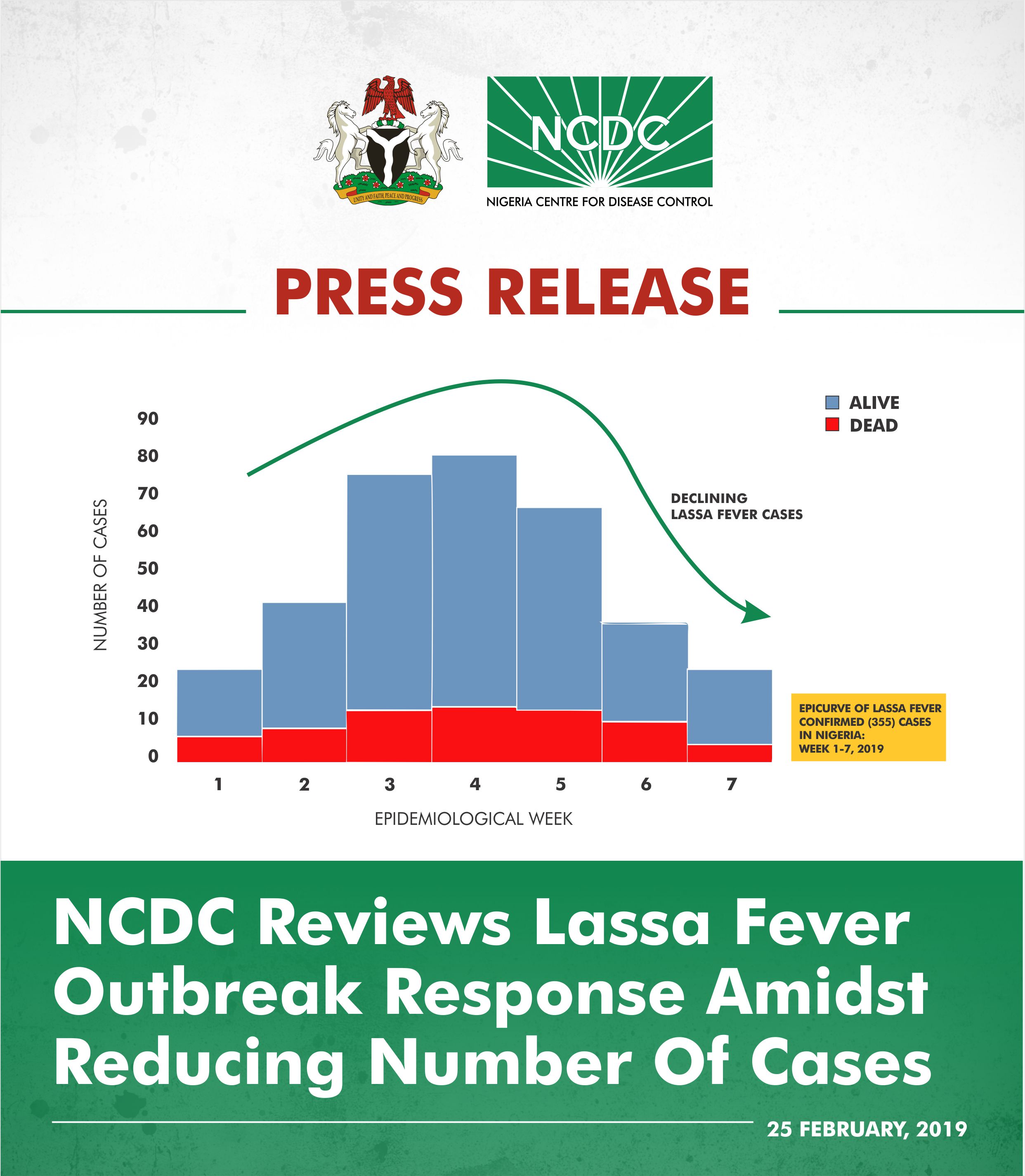
The Nigeria Centre for Disease Control (NCDC) has reported a decrease in the number of Lassa fever cases reported weekly in the country. This is following the intensive response to the Lassa fever outbreak declared in Nigeria on the 21st of January 2019.
Since the beginning of the outbreak, NCDC has activated an Emergency Operations Centre (EOC) to coordinate response activities. The EOC includes representatives from the World Health Organization (WHO), Federal Ministry of Agriculture and Rural Development, Federal Ministry of Environment, Médecins Sans Frontières, UK Public Health Rapid Support Team, US Centers for Disease Control and other partners. In addition, state level EOCs were activated in Edo, Ondo, Ebonyi and Plateau.
In the last reporting week ending on the 17th February 2019, 25 new confirmed cases of Lassa fever were reported. So far, a total of 355 confirmed cases with 75 deaths have been recorded between January 1st and February 17th, 2019 from 20 states across 57 Local Government Areas. Over the past three weeks, there has been a downward trend in new cases. The number of new cases being reported are lower, compared to the same period during the 2018 outbreak.
Despite the reduction in new cases, response activities are being intensified at the national and state level. Rapid Response Teams (RRTs), which include colleagues from Federal Ministry of Agriculture and Rural Development and Federal Ministry of Environment are supporting the response in high burden states (Edo, Ondo, Ebonyi, Plateau and Bauchi).
In addition, the NCDC has supported states in ensuring full availability of drugs, personal protective equipment, reagents and other supplies required for case management and diagnosis of Lassa fever. There has been no single stock-out reported in any state.
An outbreak review meeting was convened by the NCDC on the 15th of February 2019. The goal was to review response activities, discuss lessons learned and improve outcomes of the outbreak. The review highlighted significant improvement in the 2019 response as evidenced by the early decline in the number of cases when compared to the 2018 outbreak. These improvements have been attributed to various factors including the early deployment of One-Health national RRTs, strengthening of Lassa fever treatment centres, enforcement of environmental sanitation, introduction of the Infection Prevention and Control (IPC) ring strategy, risk communications activities, high level advocacy, operational research into response activities, and others.