

Nigeria Health Watch
Dear Distinguished Senators and Honourable Members,
Nigeria faces a “double burden of disease” where diseases such as HIV, malaria, and Lassa fever cause major illness and death and the rates of non-communicable diseases (NCDs) such as heart disease, cancer, and diabetes are rapidly increasing. This has created growing pressure on a health system already managing infectious threats. In 2019, NCDs were estimated to account for about 29% of deaths in Nigeria. In practical terms, this means roughly three in every ten deaths are linked to NCDs.

Evidence links sugar-sweetened beverages (SSBs) to rising obesity and diet-related NCDs. A report found SSBs caused 2.2 million new cases of type 2 diabetes and 1.2 million new cases of cardiovascular disease globally in 2020. In Nigeria, as elsewhere, high SSB intake contributes to obesity, diabetes, and cardiovascular disease, increasing healthcare costs, reducing household savings, and weakening productivity.
Well-designed health taxes are among the most effective tools for reducing consumption of harmful products. Excise duties on unhealthy products such as SSBs can raise prices, reduce purchases, and lower disease risk, while also generating public revenue. WHO guidance and country evaluations show that, when properly designed and enforced, SSB taxes can increase retail prices and reduce purchases.
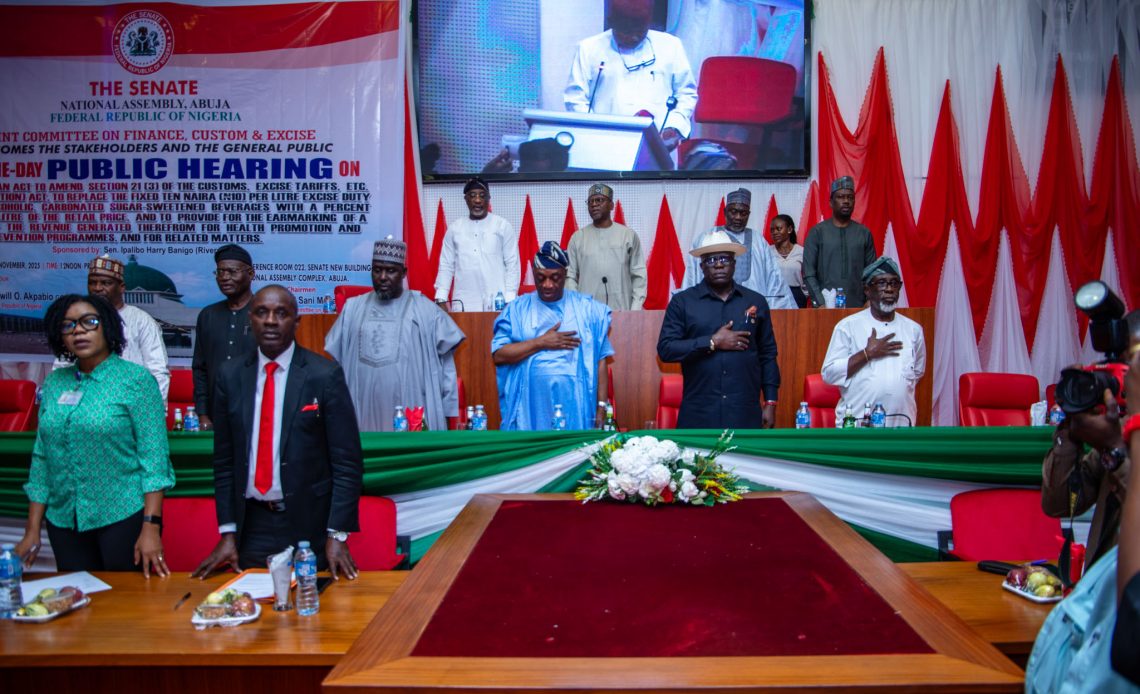
Dear Distinguished Senators and Honourable Members, the proposed amendment to Section 21(3) of the Customs, Excise Tariffs (Consolidation) Bill, would shift Nigeria’s sugar-sweetened beverage (SSB) tax from a fixed levy (₦10 per litre) to a percentage-based charge tied to the product’s retail price. If accurately drafted and enforceable, this is a practical, evidence-informed reform aligned with global best practice. Unlike a fixed levy that eats into inflation, a percentage-based tax can maintain real value over time. However, to protect the policy’s impact, the legal text should clearly define the tax base and strengthen valuation and enforcement to reduce under-declaration.
Across Africa, countries that have strengthened SSB taxes are seeing multiple benefits, including reduced sugar intake, improved public health outcomes, and increased revenue.

- South Africa: Its tiered SSB levy (2018) led to a ~29% decline in taxed drink purchases, with industry reformulating recipes to cut sugar by ~51%. It also raised R5.8 billion (US$319 million) in two years.
- Botswana: In 2021, Botswana introduced a sugar tax at 2 thebe per gram of sugar for sugar content beyond four grams per 100 ml. In the 2023–24 fiscal year, the tax generated about 100 million Botswana pula (~US$8 million).
- Ghana: Recent tobacco and SSB tax increases have dramatically boosted revenues (tobacco tax collections more than doubled from 2021 to 2023 and there were forecasts of GHS 455 million revenue in 2023).
These examples suggest Nigeria can achieve comparable health and revenue gains at scale. They also indicate that, with good design and enforcement, consumption can fall while revenue rises.
Responding to key concerns raised by industry representatives
Dear Distinguished Senators and Honourable Members, some industry representatives have portrayed the amendment as a “punitive, one-size-fits-all” policy that will deindustrialize the beverage sector, cause massive job losses, and push consumers to the black market. These claims should be tested against independent evidence.
- Studies commissioned by beverage groups often count gross losses and ignore jobs created elsewhere. In South Africa, one such industry study claimed up to 72,000 jobs would vanish under an SSB tax. Independent analysts debunked this as “patently exaggerated.” They note consumers simply reallocate spending, creating jobs in other sectors. Global evidence on health taxes repeatedly shows that industries adapt via reformulation or marketing lower-sugar products, rather than shuttering factories.
- Industry claims that higher taxes will spark a flood of smuggling ignore real-world experience. For example, tobacco tax hikes in many countries have NOT led to surges in illegal sales. Well‑designed SSB taxes make counterfeiters’ lives harder: by simplifying tax structures and using trace-and-track systems, governments can outsmart smugglers. Evidence shows that vested interests often use illicit trade fears to delay taxes; in practice, well-governed systems keep the legal market dominant.
- The amendment aligns with Nigeria’s broader reform agenda. The Presidential Fiscal Policy and Tax Reforms Committee in Nigeria is moving to harmonise excise taxes across products, and the tax powers in Section 13 of the existing CETA Act are not undercut by this amendment; instead, it modernises one element of the Act. In many countries, finance ministries and legislatures work together on tax laws: this consultative approach is normal (for example, South Africa’s sugar tax was passed in Parliament after finance proposals).
- Some argue that a higher SSB tax conflicts with the Nigerian Sugar Master Plan. In fact, a tax based on sugar content can still support local sugar use: manufacturers who sweeten with domestic sugar would pay no more than those using imported sweeteners. Moreover, incentivizing lower-sugar drinks does not nullify sugar demand, it encourages efficiency (fewer grams per litre) or substitutes like fruit. Countries like Mexico and South Africa succeeded with SSB taxes while also promoting agri-substitution programs.
- The proposed amendment dedicates part of SSB revenue to health promotion and NCD prevention. Far from being inflexible, this strengthens budget transparency and public trust. Evidence has shown that linking taxes explicitly to health gains makes people more willing to pay higher prices. For example, in Botswana and Ghana, citizens showed strong support for raising taxes when they knew funds would go to health. By mandating that SSB tax proceeds fund primary care, screening, and prevention programs, Nigeria ensures a feedback loop where higher taxes reduce disease, which reduces health costs in the long run. This approach aligns with WHO guidance that health taxes should support universal health coverage and prevention efforts.
Seizing the opportunity

Dear Distinguished Senators and Honourable Members, across Africa, health financing pressures are rising, driven by slow growth, debt constraints, and uncertainty in external funding. Nigeria is not immune. These pressures make domestic revenue mobilisation for health increasingly urgent. Despite the Abuja Declaration (2001) target of allocating at least 15% of national budgets to health, Nigeria has repeatedly budgeted below that benchmark. This reform does not require a new programme budget line, but it does require political will, clear drafting, and effective administration. If implemented well, it can generate additional revenue quickly and reduce NCD risk over time.
A call to the National Assembly

Dear Distinguished Senators and Honourable Members, supporting the SSB tax amendment is more than a technical adjustment; it is a statement of national priorities. Passing this reform will send a clear message that Nigeria puts citizens’ health first and will raise its own revenues for it. In doing so, you would:
- Protect Nigerians from preventable disease by reducing excessive added-sugar consumption. Tougher taxes deter excessive sugar consumption, saving lives and reducing NCD burdens.
- Mobilise sustainable health funding. Revenue from the levy, if transparently allocated, can support primary care, health promotion, screening, and NCD prevention and control.
- Align with global practice by adopting an evidence-informed SSB excise approach that countries such as South Africa and Mexico have used to reduce consumption and raise revenue.
- Support economic resilience by reducing future treatment costs and protecting workforce productivity.
- Build public trust through accountability by publishing revenue and expenditure reports and demonstrating measurable health investments.
Nigeria can be a regional leader in health tax policy. The proposed amendment to Section 21(3) is a decisive step towards stronger, more sustainable health financing and better prevention of diet-related NCDs. It prioritises evidence over speculation, and long-term public welfare over short-term commercial concerns.
So, we urge you, dear distinguished Senators and Honourable Members, to pass this reform without weakening its public health intent, and to pair it with clear implementation and accountability provisions.
Yours’ Sincerely,
Nigeria Health Watch.