

Olubunmi Oyebanji (Lead writer)
Two weeks into the new year, the noise of Detty December has calmed down. But one thing that December showed us again is that when we really want to, we can organise, pull crowds and come together to celebrate. This did not happen by chance. Detty December shows what is possible when policy intent and coordination are aligned. The culture and tourism sector has been positioned as an economic strategy, turning the celebrations into coordinated activities that are now being scaled up across different states in Nigeria. This has also been seen in financial services and telecommunications, which followed similar paths. Regulatory reform and market liberalisation enabled growth across both sectors, creating opportunities and giving innovators the room to invest. Health, however, not benefited from the same level of focused coordination. Reform has been slower and uneven in strengthening the health system and improving the quality of care.
That contrast became hard to ignore after a viral video by a Nigerian American content creator put it plainly. “We need to talk about the Nigerian healthcare system,” she said. In the video, she described her sister’s medical emergency, an experience that cut through the season of celebration and revealed a more complex reality. What she described is a story many Nigerians recognise but often share only in private, because speaking openly can feel like an accusation against the country we love. Yet the truth remains that Nigeria is living with two realities living side by side, quicker access to care and better quality environments for those who can pay, alongside fragile essential health services for far too many people. For many people in Nigeria, including members of the diaspora returning home with dollars and optimism, the system can still struggle to respond at critical moments.
The two Nigerias in one waiting room
In December, Nigeria Health Watch published a reminder that Nigerians should plan for their health just as they plan for the holiday season, because December brings risks that are rarely budgeted for. Now, in mid-January, after the concerts, weddings, and the visits to the village, that reminder deserves closer reflection. If a young person collapses at a concert or a child develops a severe fever at 2am, what system responds? Across much of Nigeria, the answer depends on where you are and what is available, reflecting long-standing gaps in primary healthcare and wide variation in the quality of care. This is where one of Nigeria’s sharpest inequalities becomes visible, at the point of care.
In one Nigeria, a patient can enter a health facility with electricity, oxygen, functioning diagnostic equipment, and staff on duty. In another, a patient meets a dark corridor, empty oxygen tanks, a laboratory unable to run tests, and requests for payment before treatment. Even where services exist, access is sometimes resolved by “who you know”; a friend who knows the matron, a doctor who can “help us talk to them”, or someone who can find a bed. This is why many returning Nigerians experience a form of reverse culture shock when they come home. Familiarity does not protect you from system failures when they arise; money helps, but it is not a guarantee when the chain of care is broken. With 76% of total health expenditure paid out-of-pocket, millions of Nigerians still encounter the health system as a sudden financial shock, a reality that carries serious consequences in emergencies.
Why we can organise concerts but not emergency rooms
Detty December proved that Nigeria can coordinate at scale. It also revealed what we continue to leave uncoordinated. Amid the celebrations two sobering moments cut through the noise, among many others that did not receive the same level of public attention, a high-profile road traffic accident involving Anthony Joshua, and the devastating death of Chimamanda Ngozi Adichie and Dr Ivara Esege’s twin son in a Lagos hospital.
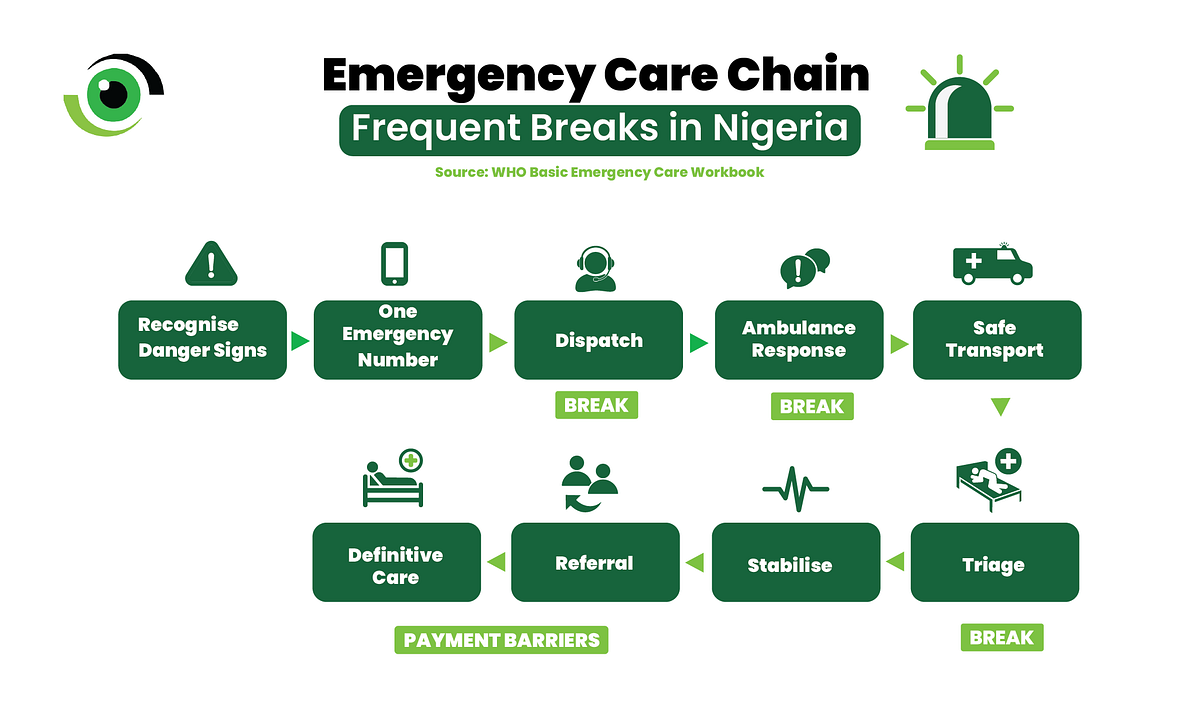
Emergency care is not magic. It is a chain, from early recognition, and a functioning emergency number, to dispatch, transport, triage, stabilisation, referral, and definitive care. Nigeria has policy intent on paper. The Federal Ministry of Health’s policy on Emergency Medical Services lays out a vision for integrated ambulance services and clearer roles for stakeholders, and the Federal Government launched the National Emergency Medical Service and Ambulance System (NEMSAS) as a pilot in 2022, aiming to strengthen emergency response at the state level. However, implementation is where our health reforms routinely fail. We still do not have a reliable emergency response in most places.
Adichie’s account raises important questions about clinical governance and accountability in health facilities. Policies exist, but oversight is fragmented, legal frameworks are unclear, and accountability mechanisms are poorly enforced. Strengthening governance means documented processes, clear protocols, and enforceable standards. Every health facility should have a visible complaints pathway with consequences. Patient safety is not charity; it is a right. The Patient’s Bill of Rights must be operationalised in every facility through clear complaints channels, defined response timelines, and consequences when standards are breached.
Existing institutions also need to function as intended. The Medical and Dental Council of Nigeria, MDCN already has a mandate to oversee professional conduct, and this process must be followed when things go wrong. At the facility level, stronger regulation and oversight is long overdue. This is why the proposed National Health Facility Regulation Agency (NHFRA) is needed, in line with the National Health Act, which makes compliance with nationally defined standards a legal condition for all healthcare facilities operating in Nigeria. While these stories gained global attention, many others never do. They point to the same systemic weaknesses, but they also risk obscuring another truth, health workers continue to show up under extremely difficult conditions. Fear, poor protection, and unclear rules have created a culture where helping can feel risky.
As one doctor, Dr Ikenna Eneze, wrote recently in a WhatsApp message that is circulating, “while a few painful stories trend, thousands of quiet miracles go unmentioned every single day.” Doctors resuscitating children with failing oxygen supplies or paying for medication out of pocket to save a life, are not the exception. They are holding together a fragile health system. Nigeria has already shown, across sectors and during the recent festive period, that coordination is possible when there are clear intent and follow-through. The challenge now is whether that same level of focus and enforcement can be extended to emergency care and clinical governance. Doing so would mean strengthening the everyday systems that support health workers, protect patients, and ensure accountability, so that moments of celebration are matched by health services that are reliable and able to protect life when it matters most. We cannot pretend the problem is only funding in healthcare, when the truth is funding, plus enforcement, plus management. The law is clear. Our practice is not.
The point of this conversation is not to kill the vibes
Nigeria’s joy is not the enemy. Five years ago, I wrote an article that was inspired by the personal experience of my father’s illness, and the fear of looking for emergency care in a system that did not seem built for urgency. Time has passed, but the underlying lesson has not changed. In Nigeria, a health emergency can still turn love into helplessness within hours.
The question now is whether we are willing to bring the same urgency, coordination, and accountability to keeping people alive, as we do organise celebration, whether those at risk are partygoers, health workers, villagers, returnees, or the parents who raised us. There is much more to Nigeria than just vibes. And one of those “more” things must be a health system that is ready to catch us when we fall.