



Safiya Shuaibu Isa and Solomon Oladimeji (Lead writers)
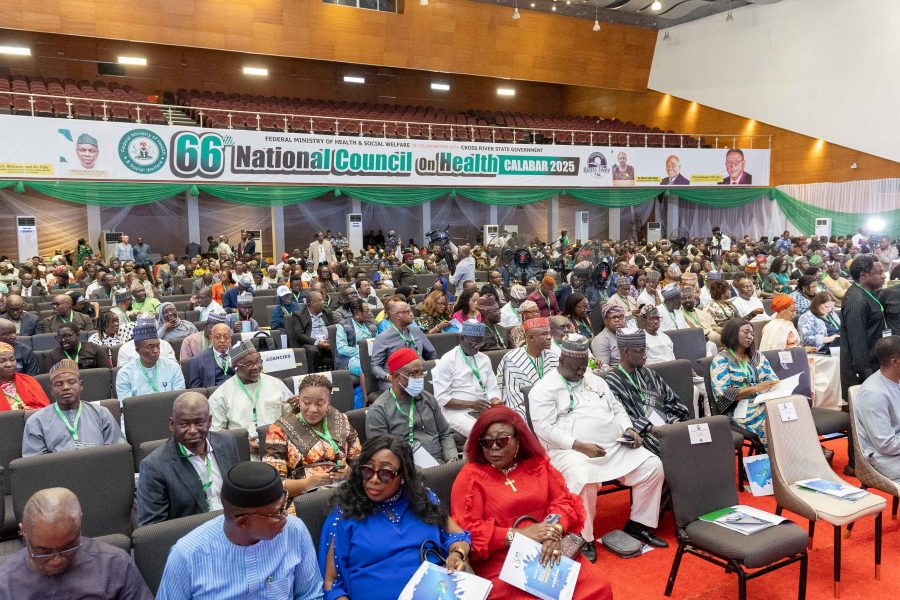
At the 66th National Council on Health (NCH), one message resonated clearly: health in Nigeria must be regarded as a right, not a privilege. This notion was strongly emphasised in the opening remarks by the Honourable Minister of State, Dr Iziaq Adekunle Salako, who repositioned equity as the guiding principle in the country’s pursuit of Universal Health Coverage (UHC). It also established a clear expectation that governments at all levels must ensure that the most vulnerable Nigerians, pregnant women, children under five, the elderly, persons with disabilities, and those facing catastrophic health conditions are not left behind.


66th National Council on Health (NCH). Image credit: Nigeria Health Watch
By placing equity side by side with a bold set of health financing reforms, he underscored a deeper truth: rights mean little without resources. The path to achieving UHC will depend less on declarations and more on the country’s willingness to confront hard questions about how health is funded, who is covered, and how quickly Nigeria can reduce its heavy reliance on out-of-pocket spending. Currently, approximately 21 million people have health insurance coverage.
Taken together, equity and financing set the tone for deliberations. They also provided the most transparent lens through which the Council’s technical discussions, ranging from PHC revitalisation and digital transformation to subnational performance and memo quality, can be understood. If equity defines the destination, financing will determine whether Nigeria has the political courage, fiscal discipline, and institutional capacity to get there.


From 17 to 21 November 2025, the council highlighted how bringing health leaders together can help shape effective policies, accelerate progress towards universal health coverage (UHC), and reinforce the need for equitable access, resilience, and innovation in the health sector.
Updates were provided on the revitalisation of Primary Health Care. With 88% of states establishing Primary Health Care Boards, and 2,127 PHCs revitalised. While progress has been made, gaps remain in validation, and there is a need for standardised and transparent tracking of PHC upgrades.
While structural reforms are advancing, many state-level commitments remain uneven and fragmented and the Technical Session’s review of the previous NCH resolutions exposed deep disparities across states. Although areas with strong federal direction have recorded notable progress, such as human resource for health (HRH) institutionalisation at 67.6% progress; warehouse upgrade budgeting at 63.9% progress, emergency transport at 66.6% progress and Vital Registration integration, gaining 57.1%, key social protection and public health areas continue to lag far behind.
These low-scoring areas are far from peripheral; they reflect the most vulnerable segments of Nigeria’s health landscape. National averages mask uneven progress, although the address recognised states such as Lagos, Kaduna, Enugu, Cross River, Delta, Kano, Ogun, Bauchi, Niger, Kwara, Edo and Anambra for their innovative approaches to health insurance enrolment, digital health integration and equity-driven interventions.

Cross River, for instance, reported 28% health insurance coverage, surpassing the national average of 17%, and established a digital UHC Coordination Centre. Edo State has become a national reference point for digital health, achieving 850,000 biometric registrations, reducing vaccine wastage by 23%, and delivering telemedicine to 12,000 patients monthly.
These models show that subnational leadership is the true engine of UHC and that progress is possible when states align political will, financing and systems strengthening.
Examples of strengthening health security efforts in Lagos
The Council also benefited from a compelling health security presentation by Prof. Akin Abayomi, Lagos State Commissioner for Health.
Drawing on Lagos’s experience with Ebola and COVID-19, he reminded delegates that universal health coverage (UHC) cannot be realised without a resilient biosecurity architecture. As Nigeria’s busiest port of entry, receiving over 70% of all international arrivals, Lagos has historically been the country’s first point of exposure to global disease threats.
Prof. Abayomi used the Lagos containment of the 2014 Ebola outbreak to demonstrate how rapid contact tracing, coordinated emergency response, and courageous frontline decision-making prevented a national catastrophe and laid the foundation for the state’s biosecurity achievements during the COVID-19 pandemic.

He further highlighted the rising complexity of outbreaks driven by climate change, megacity expansion, antimicrobial resistance (AMR), and synthetic biology, warning that Nigeria must prepare for the inevitability of Pathogen X.
Lagos’s investments in advanced surveillance systems, biocontainment laboratories (Bio Safety Levels 2 and 3), digital monitoring tools, and the new Infectious Disease Research Institute were presented as models that other high-traffic states, such as Kano and Rivers, should adapt. His central message to the Council was unequivocal: a rights-based health system must be anchored on strong subnational preparedness and fortified border-health defences, or Nigeria will remain vulnerable to the next major outbreak.
The diaspora’s role in domestic health system strengthening
Alongside these security-focused insights, the Council was also introduced to a forward-looking national initiative that leverages global Nigerian expertise. The Diaspora Health Impact Initiative (DHII) presenting on behalf of international diaspora medical associations, outlines how more than 50,000 Nigerian-trained doctors abroad across the UK, US, Canada, Germany, Australia, and South Africa are mobilising to support domestic health system strengthening.
Launched in March 2025 by the Federal Ministry of Health and Social Welfare, the DHII outlines a coordinated approach where diaspora associations align their speciality training, mentorship programmes, and capacity-building missions with the specific needs of Nigeria’s geopolitical zones.
The programme’s design is both ambitious and pragmatic: from obstetrics and neonatal care in the North-West to sickle cell management in the North-East; surgical ultrasound training in the North-Central; Biosafety Levels and management of childhood killer diseases in the South-East; laparoscopy and endometriosis care in the South-South, and interventional radiology and neurosurgery in the South-West.
The initiative aims to train 5,000 health workers, scale clinical competencies, and foster sustained mentorship networks across federal and state systems. The presentation urged national and subnational leaders to actively engage with the programme ahead of the 2026 Diaspora Health Week, arguing that diaspora-led technical expertise represents one of Nigeria’s most underutilised assets for accelerating UHC, strengthening the health workforce, and driving system-wide improvements in quality of care.

Image credit: Nigeria Health Watch
Financing the next phase of UHC
The Minister’s financing proposals signal a strategic pivot:
- Mandatory health insurance domestication.
- Doubling BHCPF coverage to 15–20 million in 12 months.
- Ring-fenced state basic healthcare funding.
- Expanded Public-Private Partnerships.
- Innovative financing mechanisms, including fuel levies, sin taxes, and a $500m Diaspora Health Investment Bond.
These ideas reflect fiscal realism: government budgets alone cannot fund Nigeria’s UHC aspirations. The challenge, however, lies in ensuring these mechanisms do not burden the poorest Nigerians or widen urban-rural inequities.
From reform to rights: The work ahead
Despite evident progress, the 66th NCH showed that Nigeria’s health system still struggles with:
- Weak state-level implementation
- Poor coordination across ministries and agencies
- Limited capacity to translate policies into scalable programmes
- Gaps in data quality and accountability
- Underinvestment in the most vulnerable groups
The Minister’s closing remarks resonated with those of Dr Tedros Adhanom Ghebreyesus, the Director-General of the World Health Organisation, who stated that “UHC is a political choice.” This encapsulated the essence of the Council’s mandate.
A call for bold, coordinated leadership
This year’s Council demonstrated ambition but also exposed the structural constraints that continue to limit Nigeria’s ability to translate commitments into tangible improvements for citizens. If Nigeria is to transform health from a privilege to a right, the post-NCH agenda must focus on three imperatives:
- Strengthening state implementation capacity, especially for neglected areas like mental health, Gender-Based Violence, food safety, and palliative care.
- Locking in financing reforms from mandatory insurance to innovative funding streams to protect the most vulnerable.
- Institutionalising accountability, ensuring that resolutions do not fade into annual rituals but drive measurable, equitable progress.
The 66th NCH has offered a clear blueprint. What happens next in state budgets, legislative chambers, PHC governance structures and facilities, as well as community systems, will determine whether Nigeria truly delivers on the promise: My Health, My Right.